
Choose Nishimuraya Honkan for a traditional ryokan stay with shared onsen and seasonal dining. Choose your exact room carefully: private room baths use heated water, not hot-spring water.
Quick decision guide
| If you want… | Start with… | Check before booking |
|---|---|---|
| A classic ryokan room | Traditional Room or Traditional Superior Room | Bedding setup, capacity and the outlook of the exact assigned category |
| Western beds with tatami space | Western & Japanese rooms, or named rooms such as Ume, Hagi, Katsura, Botan or Kumoi | Exact bed count, floor, capacity and room layout |
| A bath inside your room | A room explicitly labeled as having an open-air or semi-open-air bath | The bath belongs to that exact room type and uses heated water, not onsen water |
| A room designed for wheelchair users | Yamabuki, which the ryokan labels a universal room with second-floor elevator access | The complete route and the bathroom, toilet and assistance features your party needs |
| A private dining space in the room | Katsura, Yamabuki or Honjin | Whether the selected meal plan is served there; a dining area in the room does not guarantee the venue for every plan |
Room names and bookable inventory can change. The current Japanese room index includes Ume, Hagi and Katsura, introduced in August 2026, while the English room index checked on October 8, 2026 did not yet list those three additions. Use the booking engine's exact room and plan details as the final source for your travel dates.
Rooms: traditional, bed-equipped and bath-equipped
The room list begins with one-room and two-room Japanese-style accommodations. These are the clearest starting point if the priority is tatami and a traditional layout. The ryokan also lists Japanese-Western rooms for travelers who prefer beds. Confirm the bedding arrangement for the exact number of guests rather than assuming that every person will use a bed.
The Japanese room index currently shows three rooms introduced in August 2026:
- Ume: a first-floor Japanese-Western room for two to six guests, with twin beds, tatami space, a garden-side earthen-floor sitting area and a private semi-open-air bath.
- Hagi: a first-floor Japanese-Western room for two to six guests, with twin beds, tatami space and a garden-facing earthen-floor sitting area. Its official listing does not label it as an open-air-bath room.
- Katsura: a first-floor Japanese-Western room for two to six guests, with twin beds, tatami space, a dining room and a veranda. Its official listing does not label it as an open-air-bath room.
Other named rooms that the current Japanese index labels as having a private open-air or semi-open-air bath include Hatsune, Asuka, Matsu, Sakura, Botan, Ginsen, Horai, Kangetsu, Kumoi and Honjin. Layout and access vary. The English room pages state that both Kumoi and Honjin require stairs; Honjin is on the third floor and includes a private dining room.
Do not infer a private open-air bath from a room's size, price or the word “suite.” Book only a category whose official description explicitly includes the bath type you want.
Private room baths are not onsen
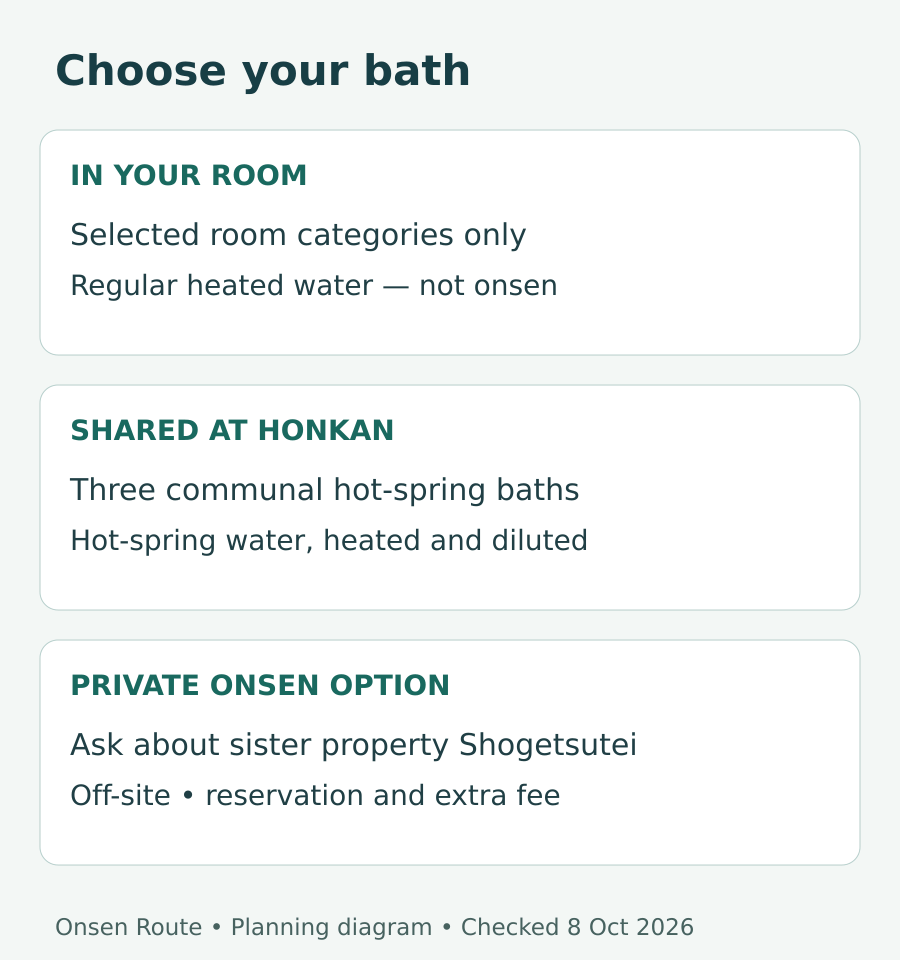
This distinction matters. Nishimuraya Honkan has three shared hot-spring baths: Kichino-yu, Fukuno-yu and, in the Hiratakan annex, Shouno-yu. These use hot-spring water; the official onsen page notes that the water is heated and diluted.
By contrast, the official room pages state that baths in privately occupied spaces, including open-air and semi-open-air room baths, use regular heated water rather than hot-spring water. A room bath can provide privacy and flexible timing, but it should not be booked on the assumption that it is a private onsen.
The bath-specific page checked on October 8, 2026 lists these hours:
- Kichino-yu and Fukuno-yu: 3:00 p.m.–12:30 a.m. and 5:30 a.m.–10:30 a.m.
- Shouno-yu: 3:00 p.m.–11:00 p.m. and 6:30 a.m.–9:30 a.m.
The ryokan's broader Japanese and English terms pages publish different generic morning closing times for the large communal bath. Because the official pages are not fully aligned and hours can change, confirm the schedule at check-in.
Guests seeking a reservable private bath with hot-spring water can ask about the private onsen spa at sister property Nishimuraya Hotel Shogetsutei. Nishimuraya states that it is off-site, subject to closures and availability, and requires a separate fee and advance reservation.
Dinner and breakfast: check the plan, not only the room
The ryokan's cuisine page describes seasonal multi-course kaiseki served privately and breakfast in the historic Senrei dining hall. Individual room pages also show in-room dining spaces for some categories. Meal content, season and venue can depend on the exact plan, so the room floor plan alone is not a promise of where dinner or breakfast will be served.
The official terms pages agree on breakfast starts at 7:45 a.m., 8:15 a.m. and 9:00 a.m. in Senrei. They do not agree on the last dinner start: the Japanese terms list dinner starts from 5:30 p.m. to 6:30 p.m., while the English terms list 5:30 p.m. to 7:00 p.m. Treat the time shown in the selected plan or confirmed by the ryokan as controlling.
Arriving late can therefore affect dinner. Confirm dietary requests, allergies, the meal venue and the latest acceptable arrival time directly with the ryokan before travel; do not assume every request can be accommodated.
Arrival from Kinosaki Onsen Station
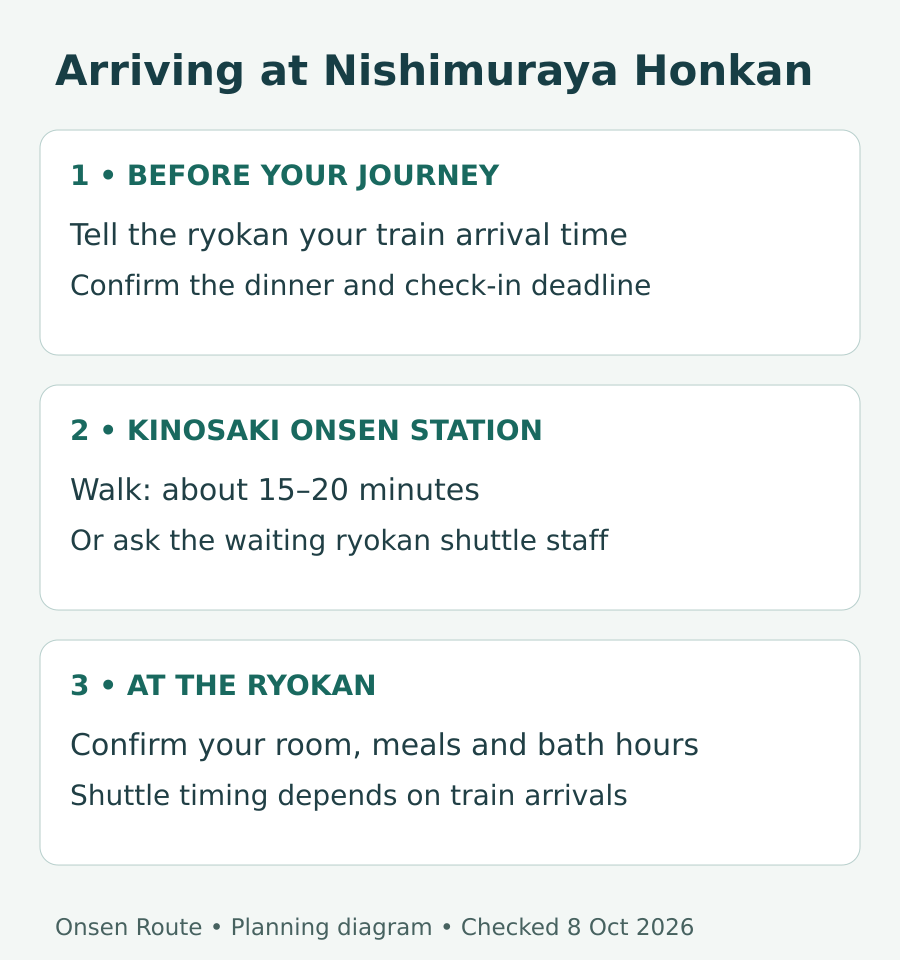
Official access map and arrival instructions
The official English access page gives a 15–20 minute walk from JR Kinosaki Onsen Station. A complimentary Ryokan Association shuttle departs after certain limited-express arrivals. Nishimuraya asks guests to provide their train arrival time before the check-in day and, on arrival, to tell the waiting shuttle staff that they are staying at Nishimuraya Honkan.
The same access page lists baggage check at the Kinosaki Onsen Tourism Center across from the station from 9:00 a.m. to 5:00 p.m. for ¥200 per item. Reconfirm availability, hours and the fee before relying on it.
The current room index lists check-in from 3:00 p.m. with a latest check-in of 5:00 p.m.; the facilities page separately displays a 3:00–6:00 p.m. range. Because the official pages conflict and dinner starts early, plan to arrive by 5:00 p.m. and contact the ryokan in advance if that may not be possible. Check-out is 11:00 a.m.
Booking conditions to verify
Before confirming a reservation, check all of the following on the final room and plan page:
- Every guest is 10 or older. Nishimuraya says children aged 0–9 cannot stay.
- The exact room name and bedding. Do not treat “Japanese-Western room” as a guarantee of a particular bed count or sleeping arrangement for the full party.
- The bath type and water source. Only specifically named rooms include a private open-air or semi-open-air bath, and private room baths use heated water rather than onsen water.
- Meal inclusions, venue and start time. Confirm whether dinner and breakfast are included, where they are served and the arrival time required by the plan.
- Stairs and mobility needs. Kumoi and Honjin require stairs. Yamabuki is the official universal room and has elevator access, but the ryokan should confirm that the complete route and room features meet the traveler's needs.
- Cancellation and payment terms. Read the conditions shown for the selected plan and party rather than relying on a general summary.
- Current availability and price. Both are date-specific and are intentionally not reproduced here.
Who should book Nishimuraya Honkan?
Choose Nishimuraya Honkan if the priorities are traditional architecture, a carefully selected room layout, formal meals and shared onsen baths. Travelers who require hot-spring water inside their private room should not treat its room baths as private onsen; ask instead whether the separately reservable private onsen at Nishimuraya Hotel Shogetsutei meets the group's needs.
For town layout, public-bath planning and how to choose an area to stay, continue with the first-time Kinosaki Onsen guide.
Check your room and meal plan
Ad · View Nishimuraya Honkan rooms on Expedia
Check the exact room, meal inclusion and cancellation conditions before booking. Onsen Route may earn a commission from this link.
Official sources and verification notes
Checked October 8, 2026.
- Nishimuraya Honkan — Japanese room index
- Nishimuraya Honkan — English room index
- Nishimuraya Honkan — Ume
- Nishimuraya Honkan — Hagi
- Nishimuraya Honkan — Katsura
- Nishimuraya Honkan — Yamabuki
- Nishimuraya Honkan — Kumoi
- Nishimuraya Honkan — Honjin
- Nishimuraya Honkan — Onsen and bath-specific hours
- Nishimuraya Honkan — Cuisine
- Nishimuraya Honkan — Facilities
- Nishimuraya Honkan — Access
- Nishimuraya Honkan — Japanese accommodation terms
- Nishimuraya Honkan — English accommodation terms